| Chemical Concentrate |
| Water | |
| Temperature | up to 160°F |
| Pressure | 35 - 125 PSI |
| Flow | 7.2 GPM @ 40 PSI |
| Supply Line | 3/4" |
| Compressed Air | up to 3 CFM |
| Hose | |
| Sanitize/Rinse/Foam | 3/4" x 40' |
| Nozzle | |
| Sanitize | 40150 |
| Rinse | 4-Hole Rinse Nozzle |
| Foam | 40150 |
Requirements
| Chemical Concentrate |
| Water | |
| Temperature | up to 160°F |
| Pressure | 35 - 125 PSI |
| Flow | 7.2 GPM @ 40 PSI |
| Supply Line | 3/4" |
| Compressed Air | up to 3 CFM |
| Hose | |
| Sanitize/Rinse/Foam | 3/4" x 40' |
| Nozzle | |
| Sanitize | 40150 |
| Rinse | 4-Hole Rinse Nozzle |
| Foam | 40150 |
Overview
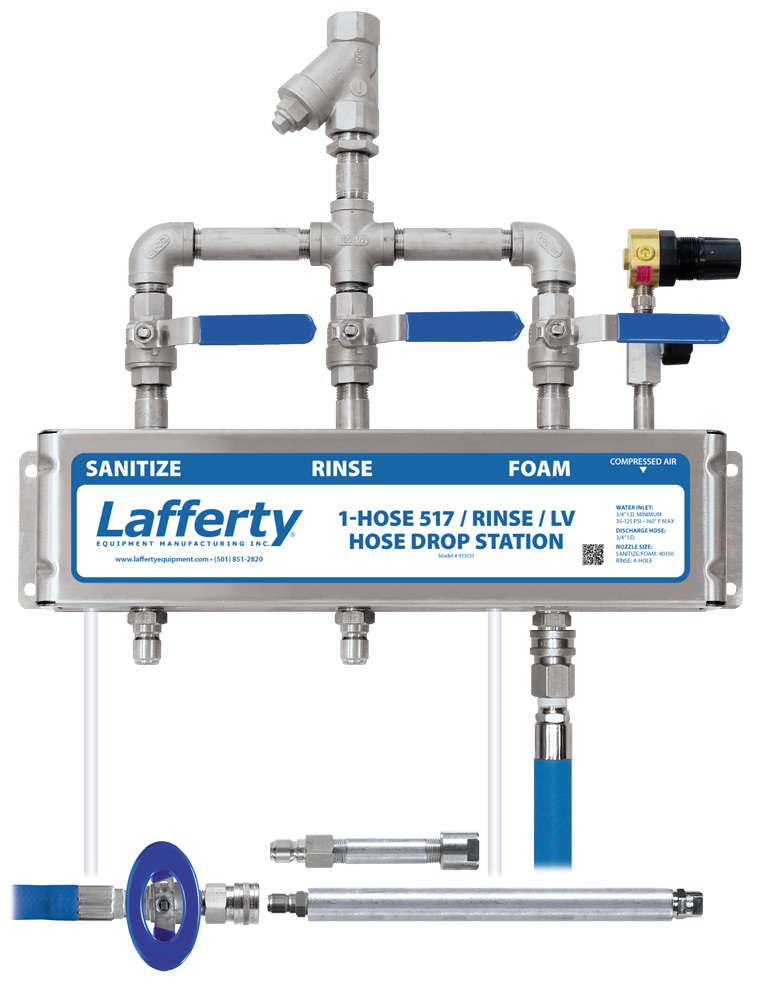
The 517 Sanitize/Rinse/LV Foam Hose Drop Station is a combination applicator for applying one chemical as a low volume of foam and another as a high-volume, sanitizing spray and for rinsing. This venturi injection system uses standard city water pressure (35 - 125 PSI) to draw and blend chemical concentrates into the water streams to create accurately diluted solutions using precision metering tips to control chemical usage. Quick-connect the discharge hose to the LV Foamer to create a low volume of rich, clinging foam by injecting compressed air into the foaming solution to greatly increase volume and coverage ability. Foam is then projected in a fan pattern at distances up to 9 feet. Quick-connect the hose to the sanitizer body to project solution as a fan pattern spray in the lean ratios required for no-rinse sanitizing in food plants. Quick-connect to the rinse plug and use the powerful 4-hole rinse nozzle to rinse at full pressure.
Safety & Operational Precautions
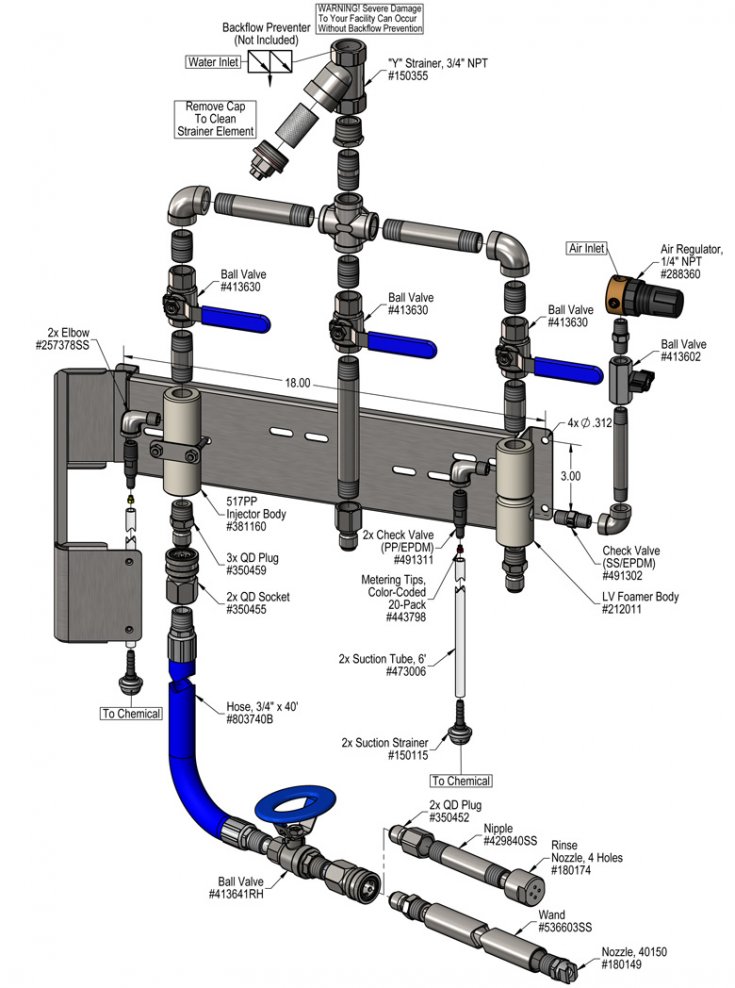
To Install (refer to diagram on next page)
Set the chemical dilution ratio by threading one of the color coded metering tips into each chemical check valve. See chemical labels for dilution ratio recommendation or consult your chemical supplier.
To Operate
TO FOAM
TO RINSE
TO SANITIZE
Metering Tip Selection | ||||
|---|---|---|---|---|
Metering Tip Color |
OZ/MIN |
Dilution Ratio | ||
| Sanitize | Rinse | Foam | ||
Brown | 0.56 | 1234:1 | — | 149:1 |
Clear | 0.88 | 785:1 | — | 95:1 |
Bright Purple | 1.38 | 501:1 | — | 60:1 |
White | 2.15 | 321:1 | — | 39:1 |
Pink | 2.93 | 236:1 | — | 28:1 |
Corn Yellow | 3.84 | 180:1 | — | 22:1 |
Dark Green | 4.88 | 142:1 | — | 17:1 |
Orange | 5.77 | 120:1 | — | 14:1 |
Gray | 6.01 | 115:1 | — | 14:1 |
Light Green | 7.01 | 99:1 | — | 12:1 |
Med. Green | 8.06 | 86:1 | — | 10:1 |
Clear Pink | 9.43 | 73:1 | — | 9:1 |
Yellow Green | 11.50 | 60:1 | — | 7:1 |
Burgundy | 11.93 | 58:1 | — | 7:1 |
Pale Pink | 13.87 | 50:1 | — | 6:1 |
Light Blue | 15.14 | 46:1 | — | 5:1 |
Dark Purple | 17.88 | 39:1 | — | — |
Navy Blue | 25.36 | 27:1 | — | — |
Clear Aqua | 28.60 | 24:1 | — | — |
Black | 50.00 | 14:1 | — | — |
| No Tip Ratio Up To: | 11:1 | — | 5:1 | |
| The dilution ratios above are approximate values. Due to chemical viscosity, actual dilution ratios may vary. | ||||
Formula | ||||
|
GPM × 128 ÷ Desired Dilution Ratio = oz/min
| ||||
Unit Flow Rates | |||
|---|---|---|---|
| PSI | GPM | ||
| Sanitize | Rinse | Foam | |
| 35 | 5.05 | 6.73 | 0.61 |
| 40 | 5.40 | 7.20 | 0.65 |
| 50 | 6.04 | 8.05 | 0.73 |
| 60 | 6.61 | 8.82 | 0.80 |
| 70 | 7.14 | 9.52 | 0.86 |
| 80 | 7.64 | 10.18 | 0.92 |
| 90 | 8.10 | 10.80 | 0.98 |
| 100 | 8.54 | 11.38 | 1.03 |
| 110 | 8.95 | 11.94 | 1.08 |
| 120 | 9.35 | 12.47 | 1.13 |
| 125 | 9.55 | 12.73 | 1.15 |
Troubleshooting Guide |
|---|
| Problem | Possible Cause / Solution | |
|---|---|---|
| Startup | Maintenance | |
| A) Foam surges and/or hose "bucks". B) Foamer will not draw chemical. C) Foam too wet. D) Foam does not clean properly. E) Using too much chemical. F) Water / Chemical backing up into air line. G) Water backing up into chemical container. H) Air or chemical solution backing up into water line. | 1, 2, 3, 4, 6, 7, 8, 9, 10 1, 3, 4, 7, 8, 9, 10 2, 3, 4, 6, 7, 8, 9, 10 1, 4, 6, 11 5 |
12, 13, 14, 15, 16, 18, 19 12, 13, 14, 15, 16, 18, 19 13, 14, 15, 16, 18, 19 17 12 20 |
| Problem | Possible Cause / Solution | |
|---|---|---|
| Startup | Maintenance | |
| A) Sanitizer will not draw chemical. B) Dilution is too strong. C) Dilution is too weak. D) Water backing up into chemical container. | 3, 7, 8, 9, 10 5 4 |
12, 13, 14, 15, 18, 19 18 |
| Possible Cause / Solution | |
|---|---|
| Startup | Maintenance |
|
|
PREVENTIVE MAINTENANCE: When the unit will be out of service for extended periods, place chemical tube(s) in water and flush the chemical out of the unit to help prevent chemical from drying out and causing build-up. Periodically check and clean chemical strainer and replace if missing. |